• Home
  • Testimonials
  • Who is Jack Bosch?
  • See Jack Bosch LIVE
  • Jack's Training Material
  • Feed on Posts or Comments

    Monthly ArchiveFebruary 2008


    Previous Posts Jack Bosch on 29 Feb 2008

    Create a Steady Monthly Cash Flow through Real Estate that allows you to work from home!!


    Working from home, isn’t that everyone’s dream? Getting up when you like to, Not having to fight traffic, working whenever you want, wherever you want.

    I would like to tell you that creating a Steady and growing monthly cash flow of $5,000 to $40,000 is not only possible but possible within 1-2 years working from home in your spare time.

    I am not saying this is possible over night but you should be able to leave your job within 1 year.

    Here is how you do it:

    1. By Investing in Tax Delinquent Property. There are several hundred thousand Properties in the US at any time with Back taxes on them and it is very easy to buy these properties at auction or even before the auction.
    2. Follow the steps I laid out in my different products available at www.secretlandprofits.com and you will be on your way to property ownership at huge discounts within 3-5 weeks.
    3. Do all your research using online sources like http://earth.google.com/ and the county webpages as well as subscriptions to companies like www.datatree.com. You can accomplish 95% of all the research you need to do without even leaving the comfort of your home.
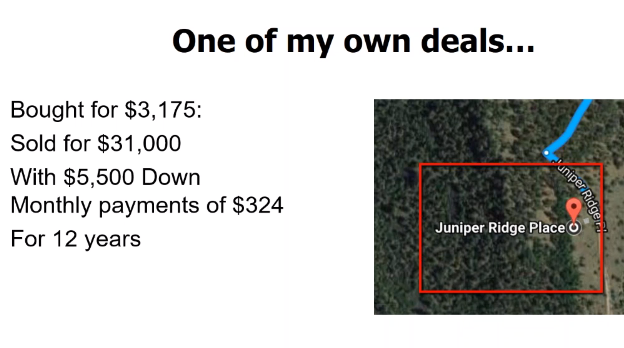
    4. Once you own a property, don’t sell it for cash but instead become the bank. Sell your properties with seller financing where you hold the note and collect the payments. A $10,000 property sale can easily be structured such that it brings you $150.00 per month for up to 8 years.
    5. Do this (step 1-4) about 20-40 times (can be done part time in one year) and you will have built up somewhere between $3,000 and $8000 per month coming in for years to come.

    What could you do with that kind of money coming into your mailbox for the next 8-10 years?

    Previous Posts Jack Bosch on 27 Feb 2008

    The Land For Pennies SIX-Week Teleworkshop

    Starting On Thursday March 13, 2008 – SIX Weeks of 3-4 hours
    training on the phone with me. It will be usually about 2-3 hours of me teaching
    and then 1-2 hours of Q&A Live on the phone with me. You can ask me any
    question you want and I will answer it right there and then.

    You will walk away with all the tools needed for a complete real estate investing
    system allowing you create real estate profits on demand. Once you implement
    this system, you’ll make BIG FAT PROFITS in CASH, create a constant MASSIVE
    CASH FLOW every month, of easily in excess of $10,000 – $20,000. Plus you
    will amass a multi-million dollar retirement portfolio of land and houses,
    owned by YOU Free and Clear!)

    Click here for detials

    Previous Posts Jack Bosch on 25 Feb 2008

    Reasons why property owners are willing to let perfectly fine properties go for taxes

    You might be asking WHY IN THE WORLD DOES ANYONE NOT WANT a property anymore or, if they don’t want that property anymore, what is WRONG with that property?

    Usually nothing: The VAST majority of all properties you can buy at Tax Deed Sales, through Tax Liens Sales and using our Direct Purchase Technique are FINE properties, many times with utilities, maintained road access, city water, trees on them, and lots of value to them.

    So why is it, that many owners don’t want their properties anymore?

    The reasons are multi-fold and as many as there are owners. But I will list what I’ve found to be the TOP 7 reasons why someone might want to let his/her property go for taxes:

    1. The owner lives out of state and just does not want to bother with a distance sale.

    2. The former owner has passed away, and the heirs now own it, have no emotional affiliation to the land and are eager to get a few dollars for it.

    3. The owners went through a divorce and need quick cash. Divorces are expensive and are emotion ridden. Sometimes one party in the divorce ends up with the property which the other party brought into the marriage. Therefore they never had any emotional affiliation to the land or if they did it is often a strongly NEGATIVE affiliation (HER LAND or HIS LAND). As a result they sometimes just want to get rid of it, no matter what, and are not willing to spend any more money on Property taxes.

    4. Life plans change: the owners might have purchased a piece of land for future retirement but then one of the spouses died the other one doesn’t want to follow through on these plans anymore. Or Plans change and even if both are alive and young, they decide they rather not move into that area but stay closer to family, children, parents, grandchildren, grandparents…

    5. Property was won at a lottery or was a gift (happens more than you think) and the owners have no emotional attachment to it.

    1. The owner was subject to one of the frequently happening land scams in the 1960s and 1970s where developments were promised that never materialized. They therefore are disillusioned with the land and are willing to just let it go. This is perfect because once you buy the land you can sell it again to people interested in just that, properties in recreational areas where NOTHING is going on. There are MANY people looking for a place away from it all to camp or build an “off the grid” Cabin.

    1. The owners bought it as a speculation but did not end up doing anything with the land and now it is just a burden.

    Previous Posts Jack Bosch on 21 Feb 2008

    Land is a Great Investment!

    If you have even a passing interest in real estate, you’ve undoubtedly heard one or more of the so-called “experts” advising against buying undeveloped land. Why? “Because it generates no income” right? Wrong, the fact is that they’re not telling you the whole story about raw land. There happens to be another school of thought entirely. And once you take notice and begin to analyze things clearly, you’ll start to see that buying land can actually be a tremendous wealth builder, one that can generate a great monthly cash flow.

    Let’s think about this for a moment. For literally hundreds of years, vast fortunes have been made in America by owning land. This has occurred in one of two basic ways: either the owner held land that lay in the pathway of progress and growth, or the owner held land that someone else sought to buy in order to change how it was being used. (Remember when the Disney Corporation bought the swamplands near Orlando?) These same basic premises work just as well today. Owning a well-positioned tract of land can return many, MANY times the amount of money invested in it.

    Aside from just buying low or in a growing area and selling the property for cash there is a whole other world that most investors overlook. People for the most part usually understand that money can be made in real estate, most people even know someone that has made it big in real estate. But the question I still always get about land investing is “How can I build a cash flow by investing in land?”. Since undeveloped land has nothing on it most people think that they will have to build a house or apartment complex on it before they can receive a monthly income stream from it. I always tell people that for years now I have been receiving a nice cash flow from my properties.

    What’s my secret? Well while every other land investor in this county is either developing the land or selling it to someone else for cash, I have been selling a percentage of my properties on terms. So when someone buys a property from me they can pay me in cash or they can pay me just a down payment and finance the rest with me for a number of years. This allows me to receive checks every month for years after. I have been able to acquire hundreds of these notes over the past few years and this has allowed me to live quite comfortably even in down markets.

    Previous Posts Jack Bosch on 20 Feb 2008

    Septic System Basics


    Roughly one-quarter of all American homes disposes of their wastewater through onsite (unsewered) systems. Using such systems, individual homeowners are responsible for the treatment and disposal of their own wastewater. Most are typically located where centralized wastewater treatment is unavailable or impractical, such as in rural areas. The most popular onsite method currently in use is the septic system. Septics use the soil to treat small wastewater flows. When properly constructed and maintained, septic systems both are reliable and safe.

    Although there are numerous types of septic systems available, all operate using the same general means. A typical system consists of a septic tank, a distribution box, and a rock-and-gravel-lined absorption field (also known as a drain- or leach field). All of these components are connected by pipes called conveyance lines.

    Tanks are normally constructed of concrete, fiberglass or plastic, and are usually of a size large enough to hold a minimum of 750 to 1000 gallons of sewage. The tank’s purpose is to temporarily contain the wastewater as solids and liquids separate. The solids (known as sludge) sink to the bottom of the tank, while scum floats on top of the liquid. The sludge and scum remain in the tank and must be pumped out periodically (generally every 3 to 5 years with a properly working system). The liquid wastewater, commonly called effluent, passes on through the tank to the distribution box. The distribution box channels the effluent into a network of perforated underground pipes in the absorption field, where it passes through holes in the pipes into the field. There it’s stored until absorbed by the soil. The absorption field treats the wastewater through physical, chemical and biological processes, effectively filtering it before it reaches the ground water.

    When installing a septic system, the main factors to consider include the size of the lot, the depth of the soil and its percolation rate (how quickly it absorbs water), and the depth to the seasonal high water table levels. If building on a parcel of vacant land, it’s also wise to determine the best location for the septic system before deciding on where to put your house and well. The required installation process can vary from state to state, and even from county to county, so contact the area’s local zoning department for advice.

    Previous Posts Jack Bosch on 19 Feb 2008

    The Basics of Wells

    Many millions of households in the United States use wells as their main source of water. Wells extract water from aquifers, which are underground layers of earth, gravel, or porous stone where ground water accumulates.

    In its simplest form, a well is simply a hole drilled down into an aquifer. A pipe and pump inserted into the hole are used to draw water out of the ground, and a screen filters out unwanted particles and other material that might clog the pipe. Wells can be a variety of different shapes and sizes, depending upon the type of earth they’re cut into and the amount of water that they’re designed to pump out.

    There are three basic types of wells:

            – Bored (also called shallow) wells are generally bored into unconfined water sources, typically found at depths of 100             feet or less.

    - Consolidated wells (rock wells) are drilled into subterranean formations of porous rock that contain no soil and do not collapse. Their average depth is normally around 250 feet.

    - Unconsolidated (or sand) wells are drilled into below ground formations consisting of soil, sand, gravel or clay material that collapses upon itself.

    The proper installation of a functional well is based on establishing its most suitable location, sizing the system correctly and choosing the appropriate construction techniques. Because of these factors, it’s advisable that only professional water well contractors should undertake the installation of wells. They’re familiar with the hydrology (which is water’s properties, distribution and effects above, on and below the earth’s surface) of their area as well as the local codes and regulations that must be adhered to – and there are a number of them. When selecting a contractor, look for certification and membership in the National Ground Water Association, a nonprofit trade and professional society that establishes standards for contractor competency. They can provide a listing of all local member contractors.

    Previous Posts Jack Bosch on 18 Feb 2008

    Water Rules and Rights


    Water is a vital and precious natural resource, and with burgeoning populations demanding more and more of its use, it can quickly become a very limited resource. That’s why every state has formed an official government department, organization or system to regulate, administer and adjudicate the water interests within its’ borders. Water rules and restrictions – which can briefly be encapsulated as “the way each jurisdiction governs who uses how much water, the types of uses it allows, and when the waters can be used” – can vary from state to state, but they also all have certain basic similarities.

    For example, as cited previously, virtually all states regulate their water management issues – whether surface or ground water (a few states have different rules for the two) – through a state Department of Natural Resources, Department of Water Management, or the Water Division of a similarly-named and responsible government office or administrative system. This will generally always be the office to contact for questions concerning the rules of water use, rights, restrictions and applications for water redirection (which simply means taking water from its source and putting it to use). Many of these Departments are headed by a State Engineer.

    Most states west of the Mississippi River administer their water law based on the doctrine of prior appropriation, which basically means that the first person to obtain a water right on a stream or other source is the last one to be shut off in times of low stream flows. The earliest date of application for a permit to use the water usually becomes the priority date of the right. East of the Mississippi, on the other hand, the majority of states use the riparian doctrine, although it’s being slowly replaced with alternative water allocation methods. Riparian doctrine states that only landowners who have water flowing naturally through their property have an automatic claim to its use. Examples of other basic water rules include the legal requirement that all ground water wells be registered with the appropriate state water-governing agency and the edict that surface or ground water may only be redirected if it’s used for a beneficial purpose without waste, to name just a few.

    Previous Posts Jack Bosch on 15 Feb 2008

    Land Surveying


    The practice of surveying land dates back to ancient history. Surveying is used for a number of interrelated purposes, such as to establish a precise location on the earth of a parcel of land along with its exact acreage, to ascertain boundaries for defining an area of ownership and tax liability, and to identify a property by a written legal description or to provide a review of the accuracy of an existing description. This data is of the utmost importance with regard to buying and selling land, and is also used to insure a clean, marketable title.

    There are many different kinds of surveys that can be performed. For undeveloped land a boundary survey is typically employed. This type of survey measures the actual physical extent of the property in question. Most surveys – regardless of type – progress through the following general procedures: first, any pertinent deeds, contracts, maps or other documents that contain a description of the property’s boundaries are located, studied and interpreted. A determination is made of what the actual property description is deemed to be, along with the locations of any physical evidence of the boundaries (in the form of both natural and man-made monuments or markers) that exist in the field. The property is then measured to establish the boundaries, not only using the appropriate existing monuments but with the creation and referencing of new markers where necessary. Measurements are accomplished using a theodolite and other surveying tools. The theodolite measures both vertical and horizontal angles, as used in triangulation networks. After these steps are accomplished, the property description and plat are prepared.

    Interpreting the results of a land survey is not as difficult as it may first seem. For instance, a property plat will usually always contain the following information: a directional orientation, typically indicated with an arrow pointing north; the bearing and distance of each boundary line; the property lines of other properties shown on the plat (also known as departing property lines); the names of adjacent property owners listed in the areas of their property that are shown on the plat; any corner monuments, along with the names of any natural monuments (such as “Smith’s Creek”, for example) or a brief description of any unnamed natural monuments (such as “the 30-foot pine tree”); and a title block containing the property’s location and name of owner, the surveyor’s name, the date the survey was performed, the scale of the plat and any other relevant data.

    If you need the services of a land surveyor, be sure that you’re hiring an experienced, certified and highly competent professional. Surveyors can certainly be found in the Yellow Pages, but word of mouth is often invaluable. Ask a relative, friend or co-worker who’s recently made use of a land surveyor’s expertise, or inquire with the local tax assessor for recommendations. Professional organizations can also be instrumental in identifying their members in your local area.

    Previous Posts Jack Bosch on 13 Feb 2008

    Finding the Land


    So you’ve decided that you want to buy some real estate and you’re convinced that raw land could be a good investment. That’s a solid choice. It’s no secret that a wisely chosen, well-placed parcel of undeveloped land can return its investment price many, many times over. And, believe it or not, there’s millions and millions of available acreage still available in this country to purchase for pennies on the dollar. But where is this land, and how do you find it?

    There are a number of ways to locate every kind of real estate that’s up (or potentially could be) for sale – and raw land is no exception. Many times property is advertised in newspapers (local, regional, national, or trade papers), by real estate brokers, on bulletin boards, or using makeshift signs posted along the road. But that isn’t always the case, especially with undeveloped property. To find great land deals, you may often have to dig them out.

    Visiting the county Treasurer’s office for the area you’re interested in is one good place to start. There you’ll be able to find all sorts of useful information. For instance, a list of owners that are currently delinquent on their property taxes. You can contact them and inquire about their interest in selling (but be sure to do this in a tactful and friendly manner). Chances are if you find an owner that is delinquent on his property taxes and lives out of state, you most likely have yourself a deal.

    Usually there is a reason why people don’t pay there property taxes and the majority of the time the reason is that they have lost interest in it, never wanted it in the first place, or just can’t afford it. You will also get the person that just forgot to pay. In either case these are perfect candidates to ask if they are interested in selling. This is exactly how I buy my investment property. Buying this way allows me to purchase land at such a low price that I can turn around and sell it quickly to another investor and still leave enough profit on the table for him to make a nice profit when he sells. I call this a Win, Win, Win transaction.

    Previous Posts Jack Bosch on 12 Feb 2008

    Land Banking


    What is land banking? Simply put, it’s the process of buying and holding unimproved real estate. Land banking is done for a number of reasons. Local governments can engage in it in order to preserve stretches of land or to have the option of changing their use at some time in the future. Individuals also utilize land banking as a potentially very lucrative investment.

    Over the years, more than a few fortunes have been realized by way of land banking. Investors who understood the concept of purchasing – at very low prices – raw land that could later be developed became quite wealthy. But it hasn’t ended; that same concept still works today. And with the current real estate bubble continuing to burst all around us and affecting virtually every category of ‘improved’ properties, investing in undeveloped land is proving to be a very sound financial decision.

    A cornerstone principle of land banking is the notion of the land’s use, not only now, but in the future as well. Unimproved land can easily be purchase with only a few hundred dollars. But the thing that will truly determine its potential value in the future is what’s known as the land’s highest and best use. In short, would the land be at its most valuable if it were used to build a manufacturing plant, or a shopping mall, or perhaps parceled out for a housing subdivision? Savvy investors use this principle to buy land that lies in the direction and pathway of economic progress. Eventually, as construction and growth move toward the property, its value begins to rise. And depending on how the land is ultimately projected to be used, the profit for the land’s owner can prove to be truly astronomical.

    Land banking can be a very effective method for funding retirement. Simply purchase a piece of land that you know is in the path of growth and progress. Then take advantage of its hefty appreciation by selling it when you’re ready to retire. If you don’t want to wait that long, buy a parcel of land that isn’t being used to its highest and best purpose and change its use, or buy for pennies on the dollar.

    I always purchase land for pennies on the dollar, so that no matter if I want to sell quickly for fast cash or hold on to for later use, I know that I will make a huge profit when I decided to sell. I have purchased thousands of parcels of land in the few years I have been investing in real estate, the majority I have sold quickly to gain wealth fast, some I sold on terms to create monthly cash flow and some I have chose to hold onto. Whenever you decide to sell or however you decided to sell your land it is up to you, my only advice is to remember that in the real estate world the profit is made when you buy and only realized when you sell. So always buy at a good price.

    Next Page »


    Rss Feed Tweeter button Facebook button Technorati button Reddit button Myspace button Linkedin button Webonews button Delicious button Digg button Stumbleupon button Newsvine button Youtube button