• Home
  • Testimonials
  • Who is Jack Bosch?
  • See Jack Bosch LIVE
  • Jack's Training Material
  • Feed on Posts or Comments

    Monthly ArchiveJanuary 2009


    About Me Jack Bosch on 22 Jan 2009

    My Belated New Years Message

    [flv:https://jbmedia.s3.amazonaws.com/video/new%20years%20message.flv 480 340]


    Click Here to Register for the Market Update Webinar
    Taking Place January 29th, 2009 at 3 pm (EST)

    Previous Posts Jack Bosch on 12 Jan 2009

    Roll It

    The list that I require each student to obtain sometimes can be extracted from the tax roll alone. The tax roll lists all properties that have unpaid real property taxes or tax delinquencies. It is just a basic list of delinquent properties, but also some details of the property (e.g. location, size) and property owners (e.g. owner’s name). The county provides it.

    Without the tax roll, you can still draft your list by looking in the treasurer’s roll. The treasurer’s roll has a tax base, telling you how much real property tax is paid annually. Knowing the tax payment can somehow point you to delinquent properties. Those without real property tax payments automatically make it to your big list. Details of the treasurer’s roll can also help you in filtering your list. Treasurer’s roll contains the same information with the assessment roll because these 2 offices share documents for land valuation, planning and development.

    Assessment roll is a technical document of the assessor’s office. It contains use code or land uses. It is basically the zoning document or land use plan, where it maps out the commercial, residential, industrial, agricultural lands. Some assessment rolls are more detailed and could inform where the flood prone areas are, lands with good soil for farming, hilly properties, highly eroded properties, tornado and earthquake lines are. It can also inform you where the forest and wildlife reserves are. These details from the assessment rolls can initially identify the brownfields or areas with critical environmental concerns.

    The assessment roll does not however inform you of real properties with delinquent taxes. Even then, the assessment rolls can still help you filter your list. The parameters provided by the use key are valuable in identifying properties in terms of land value, location, etc. It points you to the properties that are potential for buying even they are not tax delinquent.

    Previous Posts Jack Bosch on 05 Jan 2009

    One Percenters

    Tax Delinquent Property investors only account to 1% of the real property industry. The bulk of the industry is still stuck in the traditional real property investments: tax deed sale and tax lean sale. And with this small school, true tax delinquent property investing is a niche market.

    Even if I train 10,000 people in even 10 years, the proportion of my niche industry is still small, probably at less than 5%. There is an estimated 3,000 counties across the country each with 50,000-100,000 pre-foreclosed properties. Our proportion is still small at 3 trainees in every county even after training 10,000 investors.

    This niche industry I teach has so much potential because the competitive environment is thin.

    What is more attractive about this industry is I never put hefty money down to buy a property. I never waste my financial investment under my system. Unlike in traditional real property investing, you often shell out $200,000. In this industry, you usually only pay a hundred dollars per deal because most people often perceive tax delinquent properties not marketable and a burden that they sell them cheaply. The good thing of buying delinquent properties is they do not carry any investment custody or costs.

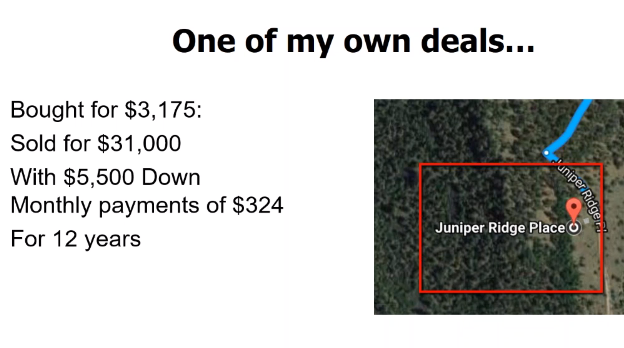
    The problem with traditional real property investment, like tax lien or deed investing is the title issue. Though you can clear those title issues by seeking certifications or title suits, those remedies accrue additional investment costs. Buying direct or following my system does not have titling issues. What more, you can buy tax delinquent properties at $500 and sell them at $3,000. You can also buy properties at $5,000 and sell them at $15,000-20,000 in the market. You thereby get $10,000-15,000 profit.


    Rss Feed Tweeter button Facebook button Technorati button Reddit button Myspace button Linkedin button Webonews button Delicious button Digg button Stumbleupon button Newsvine button Youtube button